Showing posts with label family. Show all posts

Tuesday, 26 January 2021

Italian Ice-Creams and Fish Suppers in Scotland

I have just read Mary Contini’s book Notes to Olivia about her Italian family’s early days in Edinburgh. She is the owner of the famous deli, Valvont and Crola. Scotland's oldest Delicatessen and Italian Wine Merchant and one of Europe's most original Specialist Food Shops. I will come back to the story of this a bit later.

Scotland has long enjoyed an affiliation with Italians since the first immigrants arrived in the late 1800s. It is estimated there are tens of thousands of Scots of Italian heritage, including high profile figures. Italian immigration into Scotland forever reshaped the country's culinary and social landscape.

Interestingly, post Brexit in 2016 there was the biggest surge in immigration in 100 years. One thing that makes it similar to the first phase of immigration from Italian is that large numbers are fleeing due to the lack of opportunity often in Puglia, Calabria and Sicily.

From the late 19th century, Scotland saw an increase in Italian immigrants. At this time, many Italians experienced poverty. Men fled to Scotland to make money to support their families in Italy, sending for them later. For some, it was seen as a stopping point en-route to America. Initially, they came from northern areas such as Tuscany, but emigration spread to the south by the 1900s. When America changed its immigration policy and closed the door of opportunity for many of the poorest Europeans, Scotland saw a further increase in Italian immigrants. The main reasons to seek a new life was as a direct result of economic conditions. Living conditions were harsh, with famine and sometimes droughts. Furthermore, Italy had an agricultural-based economy that was experiencing severe hardships and industrialisation was slower than in other European nations.  Many saw an opportunity to go elsewhere to earn a better living. After a slow start, in which the Italian immigrants failed to make any real economic progression, the Italians seized the opportunity to move into the catering world. Initially working as ‘hokey pokey’ men, selling ice cream from barrows, these men had been recruited in London and then sent to Scotland. They quickly moved into working-class areas, combining ice cream making with selling fish and chips. Restaurants and takeaways were established and sold food made using ingredients widely available in Scotland like fish and potatoes. To this day most Scottish towns still have an Italian chippy.

Fish and chips became essential to the diet of the ordinary man and woman, through the latter part of the 19th century and well into the 20th century. The fish and chip trade expanded greatly to satisfy the needs of the growing industrial population of Great Britain. In fact, you might say that the Industrial Revolution was fuelled partly by fish and chips! Nobody, however, could dispute the Italian influence after they had spotted the business opportunities to be had north of the border by selling pesce e patate. Stuart Atkinson, Scottish executive councillor with the National Fish Friers Federation, said their role was significant. As large numbers of Italian immigrants entered the Scottish fish and chip trade from around 1890 by 1914, they dominated the trade and opened many shops throughout Scotland.

From humble beginnings, by the 1920s these barrows had been transformed into luxury establishments in the city centres via working class areas. There are many famous Italian businesses in Scottish society like Nardini’s which boasted a beautiful Art Deco tearoom that became an key attraction. There was a greater degree of acceptance from the Temperance Movement as the cafés chose not to sell alcohol. Cafés such as these were as much an assertion of an identity in a new land as they were a business as a means of breadwinning. Helping to integrate the new arrivals into the communities of Scottish towns and cities. They were popular ventures for immigrants, and locals took very quickly to the idea. 

In Glasgow, police statistics show that in 1903 there were 89 ice cream shops in the city. A year later that number had nearly doubled, reaching 184, and by 1905 there were estimated to be 336 ice cream shops in the Glasgow area alone. Many made a living from the Scottish sweet tooth. ITally is slang for Italian and the title refers to both Italian blood and to the raspberry sauce added to ice-cream. It is fair to say that Italian cafés were at the heart of Scottish culture, but the question remains as to whether Italians were fully accepted in Scottish society. Their cafés were often the scene of unruly behaviour. This led to cries that the Italian cafés were morally corrupt, articles appeared in newspapers reporting the ‘ice cream hell’. Their popularity wasn’t universal and they did encounter some hard times along the way, which most likely strengthened the ties of the growing Italian community, who helped one another when needed. Immigrants can enrich and bring a new dimension and flavour to the customs and culture of their adopted land. And I am sure that the colourful Italian community must have added character to the dour cities, towns and villages in Scotland. 

What whetted by interest in this subject was the story of brothers Alfonso and Vittorio Crolla who emigrated to Scotland and established a small ice-cream and confectionery in 1906. They were to team up with Raffaele Valvona in 1934, by that time an elderly shopkeeper who was thought by the Italian community to need the acumen of the Crolla family. They sold easily affordable food, mainly to the Italian immigrant community. This succeeded brilliantly, helped by the fact that a lot of returning troops after the war, who had fought in Italy, had acquired a taste for the Italian meats, cheeses and olives.  Having concentrated on inexpensive produce, Valvona & Crolla made the shrewd decision, as supermarkets began to undersell local businesses, to specialise by importing the best Italian food and drink. They were to be a pioneer of healthy food, never failing to point out the virtues of low-cost tomatoes and packets of spaghetti. Alfonso died in the war, but Alfonso’s son, Vittorio continued to work with his uncle, taking over the business in 1945 with his brother-in-law, Carlo Contini.

For 40 years Victor Crolla, was the head of the family at Valvona & Crolla.  His Italian delicatessen was famous not only in Edinburgh but among tens of thousands of festival and other visitors to the Scottish capital. The language in the shop was sui generis (a hybrid between Leith Scots and High Neapolitan) It speaks volumes for the family's relationship with the Scots that during the Second World War the shop's loyal staff continued to keep it open so that there was a business to return to. Victor Crolla, stepped down in 1985, but in the words of his nephew Philip Contini who ran the shop, he continued to be the spiritual head of the store. In 2019 Philip and his wife Mary, handed over the reins to their eldest daughter, Francesca Contini Mackie, Alfonso’s great-grand daughter making this a fourth- generation family business which brings a little bit of Italy to Scotland.

I wish them a continued success; I am a great believer in family and local businesses. I also think it shows how important it is to mix cultures by immigration and hope this does continue as it enriches all our lives for the better!


Sunday, 16 August 2020

Santa Semana- Easter

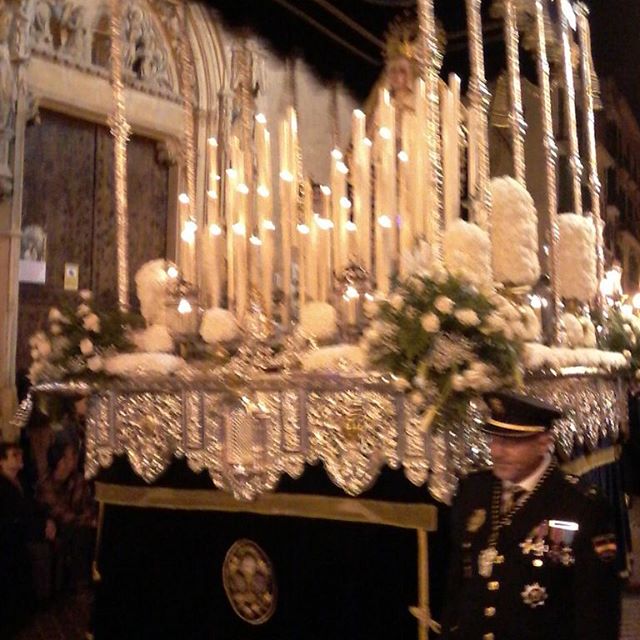
I mentioned in my last blog about Semana Santa, this is a religious festival and one of Spain’s most traditional festivals.In the UK, for most people, Easter is about giving and eating chocolate eggs. However, in Spain, religious traditions are still prominent. Especially in the case of Semana Santa, which means Holy Week.

The celebration is a week long and takes place all over Spain during Easter. Thousands of people take part in the processions and even more line the streets to watch. Huge floats carrying religious statures are brought to the churches. there are often marching bands following.  Although its a sombre occasion to pay homage to the last days of Jesus, its also colourful and captivating.


Each float depicts a scene from the Easter story and are carried by Costaleros. They are followed by Nazarenos who carry candles, torches or wooden crosses. They are dressed in full-length robes and conical hoods which cover their faces, some will be bare-footed. Its quite haunting and a bit sinister.This Spanish tradition originates from medieval times, when hoods and robes would be worn by people to show their repentance over past sins. At the back of the procession are women in mourning dressed in black lace veils called mantillas, often quite mature ladies.


All ages take part from young children to their grandparents, in villages everyone in the family takes part. I was amazed that even teenagers dress up! I have seen several processions both in small villages and Palma which is a major city. Both of these were wonderful an a sight to behold. The only word of warning is that the festivities continue for hours and its unbelievable busy, so dress comfortably and take something to eat and drink as the cafes are packed. But I would not have missed it for all the world. 


Tuesday, 14 July 2020

Bodegas Suau- Brandy in Mallorca


It would be difficult to write about Spain without talking about wines and spirits as this is very much part of the culture.

On a visit to Mallorca, I came across Bodegas Suau, which has been producing brandy for 100 years and is still family-owned. I was very kindly shown around and told the fascinating history of this company, its products and how Brandy is made. The attached museum is also very interesting. It is a short metro journey from Palma and a great way to spend an hour or so. Tours are pre-arranged so contact them first.

Brandy, is a spirit obtained from the distillation of white wine, with an alcoholic content of between 36% and 40%, and is aged in American oak barrels. 

 The Suau winemakers are true Mallorca ambassadors: ‘‘We want people to order a Suau brandy knowing that it is the best in the world, and that it is made in Mallorca.’’ The company has been approached by various national and international brands, but the family hopes to maintain the product’s Mallorcan nature and dreams of it one day making the front page of The New York Times. Brandy is a drink associated with luxury; held cupped between the fingers and palm of the drinker´s hand, it’s brought to its optimal drinking temperature by the warmth of the human body. If the pleasure of drinking brandy stirs your senses, you’ll be in your element at the Bodegas Suau, where it’s possible to become the personal owner of a barrel of this aromatic liquid gold.

Bodegas Suau was originally founded in Cuba in 1851 by the Mallorca tradesman Juan Suau, and became the property of the Barceló and Mora families after the Spanish Civil War. It’s now located in a former flour factory. The company premises are surrounded by a 1.8-metre-thick exterior wall, providing protection from outside pollutants such as noise and smells and thereby creating a microclimate in which rows of barrels full of this handmade brandy are housed.

The Suau club was founded in 1992, by Angel Zuasti. He launched a private club initially called ‘Amigos de Suau’ (Friends of Suau) so that brandy lovers could enjoy their own personalized version of the spirit. Each member of the club buys a barrel with a capacity of 32 litres; these barrels guarantee a better-quality final product than larger ones because a higher proportion of the liquid is in contact with the oak. Their brandy is then stored in the Suau cellars. Only the owner of the barrel and the producers themselves are authorized to handle the individual stocks, and only eight bottles from each barrel can be extracted in any one year in order for the brandy to meet the Suau brand standards. In this way the brandy ages approximately a year, every year .One of the exclusive privileges of membership is that every bottle is numbered. personalized with the name of the barrel, its owner, the intended recipient and the bottling date.

Juana Barceló, the company director, tells us: ‘‘every brandy and every bottle here has its own particular qualities: there are barrels which are 19 years old and others only three years old.’’ The brandy itself is 15 years old when it is transferred to the barrels. Members can choose when they take home their eight bottles: some take them all at Christmas; others take them at intervals, believing it is damaging to the barrel to take them all out at once. This of course means that every brandy is different and exceptional.

 The winery also makes sure it replaces any brandy lost during the evaporation process so that it always continues its slow maturing process. The company keeps strict records and has established a ‘numerous clauses’ with a maximum of 500 club members. Currently, 448 of the barrels have been assigned owners, and number 449 is about to be sold. Barrel number 500 is reserved for the winery to be auctioned for charity. The club is made up of many different nationalities some of the members are quite famous but they remain secret.

A visit to Bodegas Suau is a wonderful journey into the history of Spain and the New World. By combining its age-old traditional techniques and modern technology, Suau has created a particular style and a new way of understanding and enjoying the luxury and sensual pleasures of brandy. I love the idea of a bespoke brandy and creating something unique. For more details I have attached their website below.

Bodegas Suau
Carrer Cabana, 12, Pont d'Inca
www.bodegassuau.com


Friday, 5 June 2020

Celebrating Foods from the Land


As I have mentioned in my previous blog posts, farming and the crops produced play a large part of the economy of Spain. Much of the produce for Europe is grown. Traditions are often passed on from generation to generation. Now some of the festas associated with food today do attract visitors and tourists are important financially but these festivals celebrating food and the land mean far more to the locals than just money.

The Mantaca- is a family affair, once a year, on this day the famous Black Majorcan pig – Porcella Negra is slaughtered, the butcher is the matador, every section of the pig is used and preparation tasks are allocated to all the family and guests, after the work is done, food and drink is offered to all those  taking part on the day and the evening is a festa of music and dancing after the hard work is done. In some ways this seems a bit gruesome to us, but in a farming community these customs were about the survival for the villages in the winter months and everyone helped. Rural traditions have gone into decline, but in 2019, in Campos, in Majorca, a day dedicated to the Balearic sausage- from the Majorcan black pig was started this is called the Feria de la Sobrasada. Many similar days take place and now these show the gastromery of the  local cuisine to tourists.


 In Extremadura in central Spain, El Festival Trasfornterizo del Gurumelo, is a festival for a rare mushroom local to the area. Gurumelo mushrooms are difficult to find so hundreds of people turn out to look for them and enjoy the food stalls, tasters and workshops.

Sa Festa d’s Melo in Villafranca De Bonnay in September, has taken place since 1994, the climax of the day been the Concurs d’Es Melo, the biggest melon competition, a highlight in the local farmers (Meloners) calendar, there’s also a melon eating competition as well as a melon lantern festival in the evening.

Many of the festas celebrating foods from the lands are linked to harvesting, a way of having some enjoyment after the hard work is done.

LLubi, also in the centre of the island (the Pla) there are bee-keeping traditions that have gone on for centuries. Honey was once only for the upper classes. Now in June, everyone can try foods, drink even soap made from honey.

In Colonia De Sant Jordi in April there is a festival to celebrate Ses Santines, giving tours of the saltworks and giving tasters of salt-cured foods and the many varieties of salt, which is a natural resource from the island.

Later on, in the year in October is the Feria Del Pimento in Felanitix, in honour or Red peppers a key ingredient in many of the local dishes.


Sa Pobla, in the centre of Majorca is famous for growing potatoes, many end up been sold in the UK.  in June there is an evening called Fra Nocturina de La Patatas. The main square, is filled with food stalls selling typical Majorcan dishes featuring Potato as a key ingredient like: Tumblet, Coca da Patatas and Bunyols but also more creative dishes like: Ice Cream, Potato and apple strudel and Potato Brownie. The prices are very affordable and are tapas sized so you can try lots of different dishes, it does get very busy.  I really enjoyed this night and tasted some very unusual food and was surprised at how much potatoes can be used in cooking.

During the year, you will be able to find a local festa for all sorts of different foods, herbs and drinks as well as local artisan markets with a range of local foods and delicacies. It is well worth going to these to sample a real taste of the local culture.


Wednesday, 8 April 2020

Lock Down 2020


I can’t believe the length of time since my last post, I guess normal life just gets in the way!

I am writing this post in a very different time; Post Brexit and from lockdown in the UK. Most airlines have suspended their flights until June and the future is unpredictable at this point. It doesn’t seem to matter whichever country you are based as Coronavirus has affected the whole world. I watch the news and it seems more like a Hollywood film plot than real life, yet it is very real. If Brexit seemed like such a nightmare a few months ago it now seems like a distance memory.  

We can only hope that as we come to the end of this, that perhaps at the other side positive changes will come out what we are now experiencing. I don’t really think things are can go back to the status quo as so much of what we know has changed and a total recovery will be slow. Having to stay at home, not seeing friends and family, not going to work and stopping all our usual activities (most of which we take for granted) makes you re-assess what is important in the greater scheme of things what actually matters. I know having a couple of weeks or possibly months gives us chance to catch up on things we don’t get chance to do normally; reading, craft projects that were started but never finished, decorating, gardening or even writing blog posts. Many people are having to help educate their children, improve their cooking and baking skills and adapt to working from home. It’s a time of big change but also a time to show what is it important and what actually matters: family, health and community.

Travel, hospitality and retail have been badly hit and many businesses will struggle to survive, I hope that buying local and supporting smaller businesses becomes the norm rather than favouring low-cost imports. There have been Good Guys and Bad Guys though-out this and I hope that in the end the Good Guys win out and we remember the actions of companies who put profit ahead of their customers and staff.

A special thank you to the many front-line staff in the NHS, food industries, transport and councils who are working harder than ever for the benefit of others.

Stay Safe and Stay In.