Thursday, 27 August 2020

An Evening of Art and Culture


When we go on our holidays it's all to easy to sit by the swimming pool or on the beach, never really venturing out very much beyond the nearest bar. Now whilst I fully understand that most of the time you want and need a relaxing break and to get a bit of sun, which doesn’t always happen in the UK. But you know many resorts have a huge selection of art galleries and museums to visit. At some parts of the day or on certain days of the week these can be free to visit or have a reduced entry cost.  Even if you had not planned on fitting some Art and Culture into your holiday, if you do make the effort to do this you will be in for a big reward. On Sunday afternoons and evening many of the leading galleries can be free. The most popular ones can have big queues, so see if you can pre-book or arrive early. One of my favourite art galleries also has a great bar with sea-views perfect for relaxing afterwards so you can have the best of both worlds.

If you do a bit of research before you go away, you will be surprised at how much there is to do and there really is something for every taste. One of my favourite events is the Nit de l'Art in Mallorca, hosted every year in the middle of September. This is Mallorca's Mediterranean version of the Nuit Blanche concept, which originated in Paris and many cities worldwide celebrate.

In Palma, for only one night a year, many of the art galleries and museums join together to celebrate the autumn arts and culture season and the inauguration of their exhibitions by transforming the city's historic old town into a treasure trove for art lovers on Saturday night. The event started in a small way in 1997 and has grown and grown ever since. Here's what they say about it;

La Nit de L'Art is a unique event which fuses the characteristic spirit of the traditional Spanish fiestas (where people of all ages get together in public squares and picturesque streets) to celebrate, the eclectic buzz of gallery openings and the excitement of a treasure hunt mapped out within the medieval walls of one of the most beautiful historic enclaves of the Mediterranean. Throughout a single evening, the historic quarter is taken over by the art world, with tens of thousands of visitors spilling out onto the pedestrian streets and alleyways to explore some of the most exciting exhibitions, performances and installations of the year.

If this is of interest to you can download a full programme with maps of all the galleries and museums taking part by clicking the link from the website. All the main museums and galleries take part; Solleric, Baluard, Miro, Misericordia, Sa Nostra and The Caixa forum. These are all open for free as well as performances and exhibitions in public spaces and squares like La Rambla, Plaza del Mercado, Plaza Mayor and Plaza de la Porta de Santa Catalina. The old town is transformed into an enormous open-air art exhibition. Bright young talents and seasoned professionals from the artistic community take advantage of every corner to show their work to the public. Bars, cafes, studios, rooftops, facades of historic buildings, shop windows and balconies. Many hotels get involved to and its great to have a wander through these too. it’s a wonderful opportunity to see inside buildings that are out of bounds like the City Hall. Some events take part on the same night in other parts of the island like in culture- loving Pollenca, so if you are not in Palma you still may be able to see events on a smaller scale

You can even enjoy a glass or two of Cava as you peruse the art. The event starts from 7:00 pm and the galleries will remain open until midnight. You can pick up a list and map of participating galleries throughout Palma in the tourist information or the galleries themselves. It’s a fun, busy night and very well-attended by the locals and visitors alike. You have to walk a bit, so not wearing heels is a good idea. But it’s a must for art-lovers and if you don’t know much about art it’s a great way to gain insight into the art world. And wonderful for people-watching, as there are some very interesting outfits and sights to see on the night.


Sunday, 16 August 2020

Santa Semana- Easter

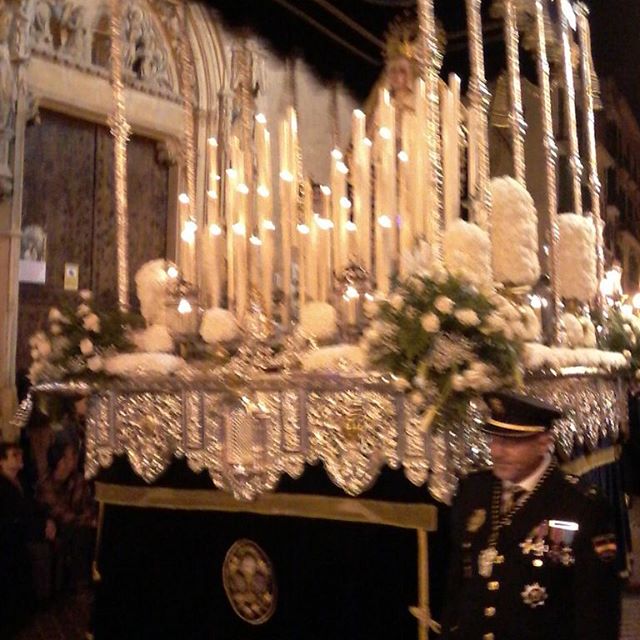
I mentioned in my last blog about Semana Santa, this is a religious festival and one of Spain’s most traditional festivals.In the UK, for most people, Easter is about giving and eating chocolate eggs. However, in Spain, religious traditions are still prominent. Especially in the case of Semana Santa, which means Holy Week.

The celebration is a week long and takes place all over Spain during Easter. Thousands of people take part in the processions and even more line the streets to watch. Huge floats carrying religious statures are brought to the churches. there are often marching bands following.  Although its a sombre occasion to pay homage to the last days of Jesus, its also colourful and captivating.


Each float depicts a scene from the Easter story and are carried by Costaleros. They are followed by Nazarenos who carry candles, torches or wooden crosses. They are dressed in full-length robes and conical hoods which cover their faces, some will be bare-footed. Its quite haunting and a bit sinister.This Spanish tradition originates from medieval times, when hoods and robes would be worn by people to show their repentance over past sins. At the back of the procession are women in mourning dressed in black lace veils called mantillas, often quite mature ladies.


All ages take part from young children to their grandparents, in villages everyone in the family takes part. I was amazed that even teenagers dress up! I have seen several processions both in small villages and Palma which is a major city. Both of these were wonderful an a sight to behold. The only word of warning is that the festivities continue for hours and its unbelievable busy, so dress comfortably and take something to eat and drink as the cafes are packed. But I would not have missed it for all the world. 


Saturday, 15 August 2020

Fiesta- A Good Reason To Have A Party


The one thing that I remember most from my travels were the sheer amount of Fiesta’s everything from parties in a private house to street parties to fiestas or fetes involving the town or city. Although religious events are often celebrated the biggest been Semana Santa at Easter, overall, any excuse seems to be a good reason to hold a party for the fun-loving Spanish.

Fiesta or Fete translates to a party, holiday or feast and usually its a mix of all three. The verb is festejar which is to celebrate, and this certainly the case from what I has seen.

In Barcelona in August, the neighbourhood of Gràcia explodes into celebration. The Festa Major de Garcia lasts a week, in the day and evening. Taking part in over 20 streets in Gràcia. Although drinking, dancing and partying dominate the evening, the festival also features cultural activities and a fire run (correc) as well as activities for children during the day.

I feel that certainly the street events brought the communities together much more than in the UK. Both young and old taking part. Although the recent pandemic has affected this and people in Britain are now more community- spirited than previously. I spent several months working in a rural location in Andalusia and the nearest small village held fiestas regularly with everyone in the village attending. Every village, no matter how small, has its own, unique celebrations.

Whilst thousands of festivals are celebrated all over Spain throughout the year there are only a few that bring overseas visitors specifically for the event. In mid- March the Falles Festival takes place. It’s a traditional celebration held in commemoration of Saint Joseph in the city of Valencia, Spain. The term Falles refers to both the celebration and the monuments burnt during the celebration. It has been declared an event of Cultural Heritage of Humanity by UNESCO. The whole of the city becomes an enormous street party, with parades, paella competitions and bullfights. Each night there is a firework display culminating in La Nit de Foc on the 18th March. The following night la Cremà takes place when all the ‘ninots’ which have been stuffed full with fireworks are burnt.

The official focus for the festival is San José, the patron saint of carpenters. Starting in the Middle Ages, carpenters hung planks of wood called ‘parots’ in the winter to support their candles whilst working. In spring these pieces of wood were burned as a way of celebrating the end of winter. After a while they began to put clothing on the ‘parot.’ These became the forerunners of the contemporary ‘ninots’ the enormous papier-mâché figures of today. It’s a loud, busy, colourful festival, not for the faint-hearted but a wonderful experience.

Medieval history is celebrated in many of the festivals in Spain. The annual Medieval fair in Capdepera, in Majorca, is set in the streets leading up to the Medieval castle that overlooks the town and is a popular event for adults and children alike. Blacksmiths, silversmiths, carpenters, shoemakers and ceramists are among the long list of artisans who offer Medieval inspired products to sell. Expect to see jousting, jugglers, falconry displays, stilt-walkers and fire-eaters. Traditional food and drink stalls are scattered throughout the event selling all kinds of Medieval fair. It wouldn’t be a Spanish fair without an excessive amount of food! The finale is a walk up to the castle by candlelight, which was atmospheric and an unforgettable memory.

 A similar festival takes place in Ibiza. To celebrate the declaration of Ibiza's Dalt Vila as a UNESCO World Heritage Site in 1999, every May the old- town hosts vibrant celebrations including three days of street parties, musical performances, artists and medieval re-enactments. As an added bonus, entry to all galleries and museums in Dalt Vila is free during the festival.

If you are planning a holiday do look in the local guides and see what is going on as not only is this great, often free entertainment it’s a wonderful way to see the culture and understand the history of the area.Many festivals have been cancelled for 2020 but I am sure they will be back with a great big bang in 2021.


Thursday, 6 August 2020

Solo Travel

When I decided to set of on my solo journey a few years ago, this was seen by some as a slightly odd thing to do. But I didn’t have a partner in crime to travel with and too be quite honest although I was a bit nervous about travelling alone, I was also excited by my solo trip. Travelling solo is a huge opportunity to see the world on your own terms without having to compromise with someone else’s plans. Your schedule is entirely yours to decide. Solo travel is something everyone should try at least once in their lifetime. There's no better way to get to know who you are as a person than by spending time with yourself away from the distractions of everyday life. Whilst It does take a certain amount of confidence to find your own way and engage with strangers, the good-points definitely outweigh the bad. So go on, embrace your inner Shirley Valentine.

Surprisingly, one in three Britons will now set off on holiday alone this year. Companies organising small-group adventure tours and escorted journeys report that as many as half of their customers now travel on their own. In part this is due to the fact that a quarter of all adults have never married or are now divorced or widowed. Many keen travellers have partners who either cannot or will not travel with them. I am not saying that travelling with family and friends cannot be incredibly rewarding and enjoyable, because it can be a wonderful experience this is just a different way of travelling. When you are away with people you know well, you can find yourselves talking about the usual things like work or people you have in common etc. Also, a solo traveller, can also seem more approachable. If you’re with a partner or friend, it’s tempting to talk mostly with each other, and outsiders might not want to impose. But if you’re by yourself, it’s often easier for someone else to strike up a conversation with you or vice versa. If I stopped for a coffee or something to eat, I often found myself sharing a table with stranglers and I met some lovely people from many different countries and had some very interesting conversations.

Travelling alone makes remaining in your own comfort zone impossible, which can lead to a more intense travel experience. You have to turn to the locals more for human interaction giving you more opportunities to learn a different language or improve your language skills. I made friends with a few locals and this gave me the chance to really see what it was like to live in a different country and I have remained friends. Travel offers you the chance to make friendships that may last a lifetime.

The biggest problem with solo travel is finding suitable accommodation as most travel companies usually offer rates based on at least two people travelling. The single supplement charge added to rooms for single travellers can be very high and can make travel for singles too expensive. However, due to the demand, tour operators and cruise lines are finally starting to cater for single people. There are also many specialist singles tour operators offering a wide range of trips like short breaks in Europe to Trip-of-a Lifetime destinations around the world. On a personal note, I use Airbnb and Homeaway and have had great experiences, both renting small apartments on my own and renting a room in a shared house. I prefer this as I don’t enjoy staying in hotels all that much. If you do like hotels, larger tour operators like TUI offer a range of hotels with single rooms to suit every kind of budget. I found their website their bit difficult to navigate as it kept taking me back to booking for two adults. I think a good travel agent can probably offer you assistance in booking your holiday.

If you are travelling alone for whatever reason and would prefer to go on an arranged trip or holiday, there are quite a few companies about that offer this service. I researched this market and found one of the best to be One Traveller, which is an online company.

One Traveller was founded in 2007 by Ian Darkin. Having worked as a Tour Manager for ten years, he saw that single travellers often felt marginalised or awkward when mixing with the couples who usually made up most of his tour groups. Eventually, Ian began organising excursions for these individuals within the holiday’s free time and from there, the idea of what would later become One Traveller emerged. One Traveller was founded as a specialist holiday company specifically for mature single travellers. The principle of their holidays is that guests are made to feel welcome and included, with nobody left on their own, unless they wish to do so. There is no stipulation of marital status, however no couples are allowed either. Guests simply need to be travelling alone. There is a wide selection of cruises, train tours and bus tours. Taking into account its more mature market these are cultural, scenic or classical cities. It would be a great way to see how you like travelling alone but with company on hand if you felt you needed it.

Overall, I found solo travelling a very positive thing, you need to take some simple precautions in order to keep yourself safe. I left an itinerary with a family member with contact details so I could always be traced. Use some common-sense, by being cautious when out alone after dark and researching unsafe neighbourhoods. I was due to visit Barcelona and a work colleague told me she had been mugged in the daytime. Now this was alarming but she advised me to wear my handbag, across my body, and to put a scarf over the top to hide it and stay alert. This also works for markets and other busy areas. One downside of travelling alone for longer periods of time with no constant routine in your life is that it can be draining and you may struggle with issues of loneliness. I did encounter this a little bit, from time to time. Homesickness is something every long-term traveller must deal with. But you know, I just told myself how lucky I was to be able to go on such a wonderful trip. Finding something to do that makes you happy like going to an art gallery or the beach can help. Reading is great and learning the language keeps your brain active. I taught myself how to cook local dishes, eating and drinking, not to excess, is a wonderful way to really absorb the culture.

By being able to sort out problems or figure out where you are when you’re lost can give you a new sense of confidence and faith in your own resourcefulness. My map-reading skills started at a poor 2/10 now I am a solid 8/10. I learnt the bus and timetables so well I helped out other tourists too.

When you venture out into the world on your own, you eventually need to face who you are, what you care about, and what you want to do with your time. For me this carried not only into other trips but also into my life at home too. It was a journey of the mind as well as the body.

I wouldn’t have missed my trips for the world. I can fully understand why a journey is at the centre of many of our greatest and most significant myths, novels, and memoirs. Travel changes you forever….


Tuesday, 28 July 2020

Speaking the Lingo


One of the most important skills you can have as a modern citizen is the ability to communicate with a wide variety of people. One way to achieve this is to speak more than one language.

The one thing that has become even more apparent when I go on my travels is how bad, the English are as a country for learning a second language. Now I know that English is a universal language, but that’s not really an excuse. Also consider that Chinese Mandarin is spoken the most followed by Spanish, well that’s a surprise! Although French and German are taught in schools, certainly when I was at school, languages were never seen as important as other subjects and certainly were not taught in the same way as other countries. As a teenager, I went on a French exchange trip, and in France, languages were much more popular with pupils, with the option to learn several languages. Now as an adult, I have tried to keep up my skills by listening to language tapes, discs and books and attending a few courses. I am currently using the Duolingo app on my phone which is very user- friendly and I would highly recommend.

When I visit overseas, I do try to converse as much as I can and even learning the basics like: hello, goodbye and thank you, I always find are much appreciated. My Spanish friends have taught me bits and pieces and this is very different from what is taught on language discs. Paul Noble, a very talented linguist, has been working with the publisher Collins, and his no- nonsense guide to learning a new language is a breath of fresh air.

The world has become smaller, we can have friends, family and even work colleagues who live in different countries, so all the more reason to learn a different language. Learning commonly spoken languages opens up a world of opportunities to be able to communicate with a bunch of new people. Another good reason to learn a language is that you’re travelling to a place where the language is spoken. If this is your reason, you probably don’t need to achieve fluency (unless you want to!) and instead should focus on useful phrases for getting around town, ordering food, and other practical activities.

I had an Italian boss, who taught her children to speak both Italian and English from birth, so now both her children are bi-lingual and she is now doing the same with her grand-children. Paul Noble, speaks about the ability to speak languages has been seen as a gift, and despite his skill, at first, he didn’t find it easy, which is good news for us all. Paul states that to practise regularly and just having a go and keeping going is all that you need.

I find I don’t always keep up with my languages but I am going to try to, moving forward. My friend told me about Duolingo and you can learn for as little as 5 or 10 minutes a day. So, on your lunch time break or on the bus or train on the way to work would be ideal. Duolingo makes language-learning fun and its easy to use. There are different types of exercises, from simply translating words to listening to excerpts and being asked to type what you heard. There are also interesting and interactive stories that put the language to use for Spanish, French, German, Italian even Chinese. The game-like setting ensures that you’re never bored and challenges you to complete goals and learn more. There are other services out there as well, like Babbel which is also a free app, I think.

Another entertaining way to monitor your progress and learn some new words or phrases is to explore the media in your target language. This could be the news, podcasts, radio, movies, TV shows, music, literature, or even children’s books. Basically, anything that is uses the language in context. it can help your comprehension (reading or listening, depending on the type of media). This forces you to exercise the parts of your brain that are used for language comprehension. It can also teach you popular words or phrases that might be helpful to know. Watching the news or a movie or listening to music will show which words and phrases are most common in the everyday usage of the language.

Learning a new language is no small feat. It requires time, energy and patience. The rewards, however, are incredible, so I encourage you to put in the time and effort required. Speaking another language is a great cognitive skill too, giving your brain a workout, Duolingo also has a resource on its website, for finding language gatherings and events for the languages it offers which has to be a further reason to try it out.

So what are you waiting for?


Monday, 20 July 2020

The History of Wine-Making in Spain


It would be impossible to talk about travelling in Spain and not touch on wine,as its history is so relevant to both the country and culture. Spanish wines are some of the richest in the world both delighting and challenging the drinker and are highly revered by international connoisseurs. Spanish wine production forms a vital part of the country's economy both in terms of exportation and tourism. 

Owing their prominence to a turbulent history, unique topography and the incredible spirit of the Spanish people. Spain is the third largest wine producer in the world and has 69 distinctive wine regions. Spain is a large country geographically and has more acreage under grape cultivation than any other country in the world although many vineyards are low-yielding. Firmly rooted in tradition and steeped in history but at the same time modern and vibrant, Spain is a study in contrasts and just like the climate and geography offers a spectacular variety of wines. Grapes are grown throughout every region of the country with Castilla-La Mancha having nearly half of the planted acreage followed by Extremadura, Valencia, Castilla-Leon, Catalonia, Murcia and Rioja. About two-thirds of all wines produced in Spain are table wines with about one-third comprising of high-quality wines. Red wines tend to outnumber whites. Jerez is famous for Sherry and the sparkling wine known as Cava is from Penedes.

During my time in Spain, I was involved in grape picking, worked in a small bodega, where I saw wines been made and was invited into a small Andalusia village to try wine from a private bodega. Many villages have their own vineyards and everyone takes part in grape-picking and the wine gets shared out. I visited a wine festival and tried, for research purposes only, many wonderful local wines! Holiday companies now offer tours around Spanish wineries and vineyards and I can see the appeal of visiting the breath-taking countryside and sampling the wines of Spain along with tasting the traditional cuisine. From rustic to refined, to innovative, red, white, sparkling and fortified. A feast for all the senses you will never forget.

The history of wine in Spain is so old that no one really knows who first brought vines to the area. Though many archaeologists believe that grapes were first cultivated sometime between 4000 and 3000 BC. By the time the Phoenicians arrived 3,000 years ago and founded the trading post city of Cadiz, viticulture was well established and Spanish wines became widely traded throughout the Mediterranean and North Africa.

When the Romans conquered Spain, they brought new wine-making methods. Under Roman rule it  was a golden age for Spanish wine. The two main production areas were the areas now called Tarragona and Andalusia. After the decline of the Roman Empire, the barbaric tribes from the north of Europe invaded the Peninsula and there is little information about wine history during these times. Most probably these tribes drank some kind of rustic beer or wine.

The 8th-century invasion by the Arabs meant there was a religious ban on alcohol. Although, they never prevented Christians from producing their own wines. In fact, the Muslims like to eat the grapes that grew on the vines, these were dried out and consumed as raisins.

The Middle Ages brought monks from different orders from all over the world to Spain. They played a very important role in the establishment of wine cellars and wineries.The monks also brought new types of vines (different from the Spanish types of vines) and new techniques. Wine-making flourished with the rise of Catholicism. The Reconquest also reopened the wine exportation business and the city of Bilbao positioned itself at the head of it. Most of the wines sold at this time went to the English markets, where they were as highly valued as French wines.

The discovery of the New World by Christopher Columbus opened up the exportation options and the Spanish conquistadors took Spanish vines with them in order to start wine production in the new Spanish colonies. This was the beginning of wine history in the New World. The 15th and 16th centuries saw a huge rise in the popularity of Spanish wines, which were being produced in almost every area of the Iberian Peninsula.

With the arrival of the Industrial Revolution came better machines for wine making, and Spain saw a decline in the exportation of its wines. There was a brief respite when the vine louse- Phylloxera destroyed most of the Northern European vineyards during the 19th century. It was a dire time for Europe and Spain was its salvation. The plague hadn't reached the Spanish vineyards so there was plenty of wine to export to the parts of Europe where all the vineyards had been destroyed.

Winemakers from France crossed the Pyrenees Mountains bringing with them new grape varieties, modern techniques and tools. The north of Spain, specially Navarre and the Basque Country especially benefited by this and their wine tradition was much richer during this time than the rest of Spain's, because they had access to the great French wine making culture.

However, the luck didn't last, as the Phylloxera bug arrived in Spain later that century. Due to the country's geography, the plague took longer to spread, so when things started to look really dire,the cure had already been discovered. It consisted of grafting tougher vines, like the American rootstock which was immune to the bug, to weaker vines, to create a hybrid that could stand against the epidemic resulting in less damage to Spanish vineyards. If it weren't for this remedy, it's likely that wine-making tradition in Spain would not be as important today.

The wine- making industry would still face more problems before reaching its modern- day postion. World War I paralyzed the European trade market, which made exporting anything almost impossible. Then the Spanish Civil War froze the country, and while the different sides were fighting each other the vines were left unattended and some of them were even torn up to plant wheat and other cereals used in basic foods. Even when the war ended, the problems did not cease. World War 11 immobilized the European market and made it impossible for the industry to take off until the 1950s. It was around this time that some of the vineyards were replanted and the wine-making tradition began to be restored in some parts of Spain.

The first half of the 20th century left Spain wracked by war and economic disruption. Since the 1950’s Spain’s winemakers have worked steadily to improve the quality. In the 1960s came the international rediscovery of Jerez and Rioja. But the real resurgence arrived when Franco died in 1975 and the transition to democracy began. The economic freedom gave way to a growth of this market between the middle Spanish classes and the revolution came to the wine industry at the beginning of the 1980s. The tourist industry introduced wines to many who had not drunk this before. 

When Spain became a part of the European Union in 1986, this brought economic aid to the Spanish wine sector and new legal standards for wine were put in place. The 1990s gave way to the acceptance in the use of international varieties of grapes like the Cabernet Sauvignon and Chardonnay, and the ban on watering which had been imposed during a drought period was lifted in 1996. This meant new places to plant, more grape varieties and more profitable ways of production. The golden age of Spanish wine had started. Now, a new generation of winemakers have quietly begun crafting spectacular wines, including organic, and experimenting with varieties that would have been unthinkable only a short time ago.

Wine remains an important commodity and an integral part of Spanish culture and tradition. So why not contribute to keeping this great history alive by enjoying a glass of wine in Spain. 

Who can resist, well I can’t, make mine a large glass of Rioja please.


Sunday, 19 July 2020

Authentic Local Shopping


Buying locally and from small independent businesses is very important to me. Choosing to buy local is a great way to get started on your journey towards sustainability whether you’re traveling or going about your everyday life. So many shops and markets are stocking items produced in China or India both at home and abroad. Its vital to support local businesses by buying their goods. Now sometimes this is more expensive but if we don’t support hand-crafted goods then it will no longer be possible to buy hand-crafted goods when these businesses cease to exist, which would be a huge shame.

 As conscious consumers, it’s important we think about buying souvenirs more as a way to support and to learn about the communities we visit rather than just about a memento of our trip. Many shops and markets are flooded with ubiquitous souvenirs that can be found anywhere in the world, so why not buy locally made handicrafts instead. Research has found that people are more likely to use and keep locally-crafted souvenirs for longer. Handcrafted jewellery is often more eye-catching than a snow globe which can be found in destinations all over the world. Look- out for items made from recycled materials and sourced directly from craftspeople in markets, villages and road side stalls. 

Friends and family appreciate a gift that is out of the ordinary and one they can use rather something that gets thrown in a drawer or the bin when you're not looking. A big part of responsible travel is supporting the local community, helping it to grow and flourish. It’s making small choices that make a big impact on local economies. The global souvenir business is worth billions of pounds and often provides vital income to the people who need it most, but in a largely unregulated industry, it’s almost impossible to stop the flood of cheap imports that take business away from genuine local crafts people. It is through shopping that you, as a traveller can directly affect a positive, responsible tourism outcome.

When I travelled around Spain, I spent a little bit of time (well quite a bit of time really) looking in traditional shops rather than the high street shops. It is possible to shop in many of the same shops as in the UK, even Primark has come to Spain. But the question I ask is why would you want to buy the same things you can get from home? Visiting local communities is a great way to find unique souvenirs and support local craftspeople and traditions. When you talk to locals that aren’t representing a corporate brand, you really get the chance to find out what daily life looks like in their hometown. You get a more in-depth view when you shop at small, locally-owned businesses. If people live in the same community where they own a business, they’ll be more invested in the needs of their community. Their decisions won’t just be about what’s best for their business but hopefully will take into account local needs. 

Trying to get closer to the source of production and engaging with artisans, allows you to discover more. Many artisans are proud of their wares and like to imagine their products finding a good home. If you can get the story directly from the artisan, the object comes to life with its story.

 I have found some wonderful authentic shops selling baskets, hats, ceramics and so much more. I think to buy a product which is locally made by hand is a very special thing. By doing this it ensures the survival of rural crafts and supports local business. Unfortunately, in Britain we have started to lose many traditional crafts and young people are not learning these skills, this is such a huge loss on many levels. We have to recognize this and place value in craftspeople from all nationalities, unless we only want to buy shoddy mass-produced merchandise in the future.

I hope this is food for thought.